
History & Tradition of Welsh Love Spoons
Origins — A Tradition Born in Wales
The Welsh love spoon is one of Europe's most enduring folk traditions. The earliest documented examples date to the 17th century, though historians believe the practice is considerably older, rooted in a time when skilled craftsmanship was one of the most direct ways a man could demonstrate his character and intentions to a prospective partner's family.
The word 'lovespoon' — or 'llwy garu' in Welsh — describes a wooden spoon carved not for use at the table, but as a gift. Unlike a functional utensil, the love spoon was purely symbolic: an object of beauty and meaning, made entirely by hand, given as a declaration of affection, devotion, or courtship. The more intricate the carving, the more serious the giver's intent.
Wales was not alone in this tradition — similar carved spoon-gifts appear in Scandinavia, parts of Central Europe, and among Welsh communities in Patagonia, Argentina, where Welsh settlers preserved the tradition for generations after emigrating in the 1860s. But it is Wales where the tradition is most deeply rooted, and Welsh love spoons remain one of the country's most recognisable cultural exports.
“The lovespoon was a man's way of speaking without words — every cut of the chisel said something that the tongue might not dare.”
— Welsh Folk Tradition
What the Symbols Mean
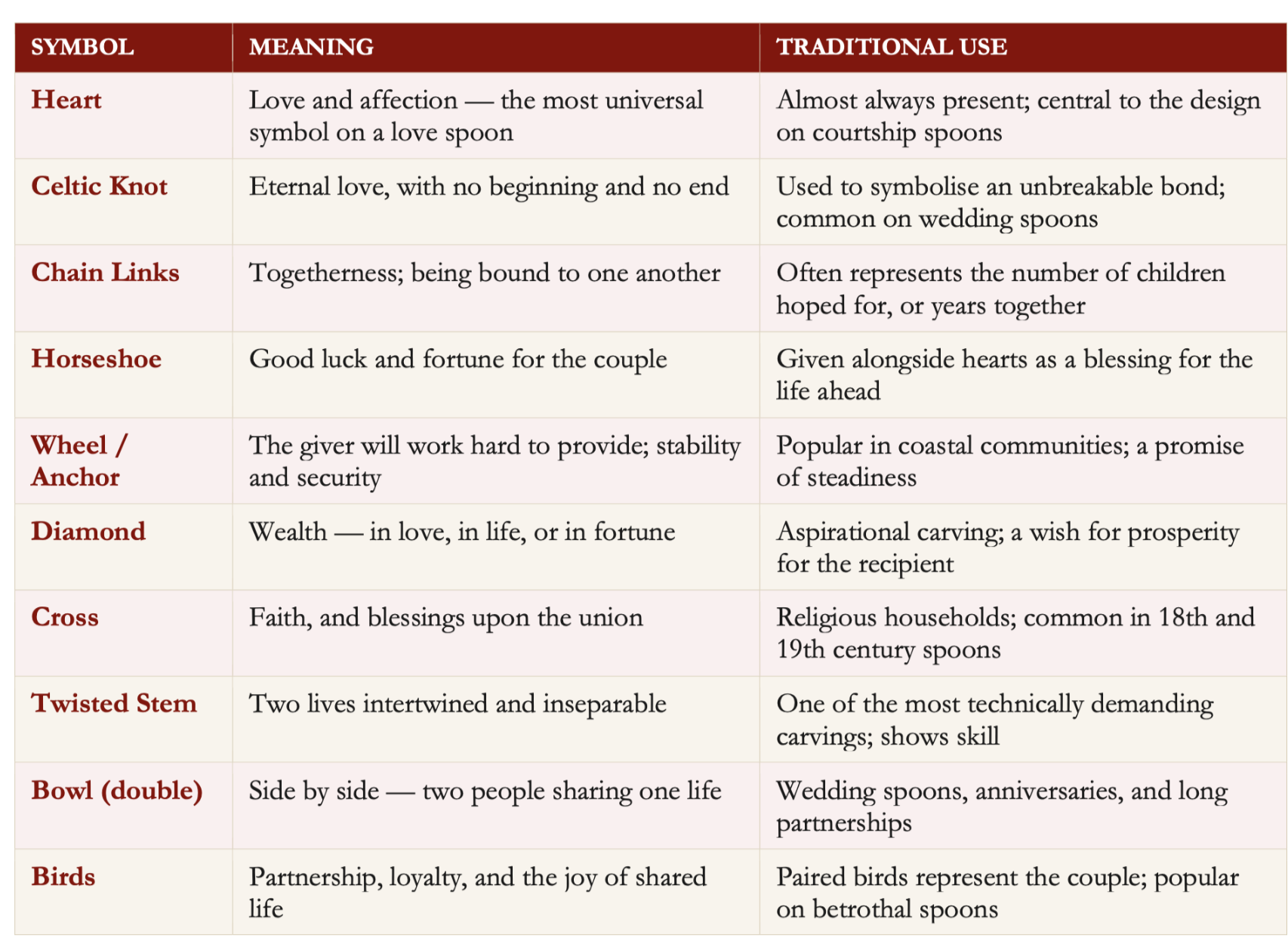
The power of a Welsh love spoon lies in its carved symbols. Each element has a traditional meaning, and a skilled carver could compose an entire personal message within the design of a single spoon. Some symbols appear on nearly every love spoon; others were chosen specifically to reflect the relationship between giver and recipient.
How the tradition was passed down
For much of its history, the love spoon tradition was an act of domestic craft rather than fine art. Welsh farmworkers and laborers would carve in the evenings by firelight, using whatever tools were available — a penknife, a small gouge, a piece of scrap timber. The results ranged from charmingly rough-hewn to extraordinarily refined, but the intention was always the same: the carving was an act of dedication to the person who would receive it.
By the late 19th and early 20th centuries, as industrialization changed rural Welsh life, the tradition began to fade from everyday practice. It survived largely because of collectors, folk museums — particularly the Museum of Welsh Life at St Fagans, near Cardiff, which holds one of the world's most important love spoon collections — and the continuing practice of Welsh craftspeople who kept the skills alive.
Today the Welsh love spoon has undergone a quiet revival. It is recognized internationally as a symbol of Welsh identity and romantic tradition, and hand-carved examples are sought by couples looking for wedding gifts, anniversary presents, and heirloom keepsakes that carry genuine historical weight. I am bringin this tradition to Erie, Pennsylvania, carving each spoon from American hardwoods selected for their quality, beauty, and longevity.
Care and display
These are display pieces. Hang it on a wall hook, stand it in a rack, or display it in a shadow box. Dust with a soft cloth. Re-oil every 12 months with food-grade mineral oil to keep the grain hydrated and the surface lustrous. Keep away from direct sunlight and heat sources. With minimal care it will remain beautiful for a lifetime.